
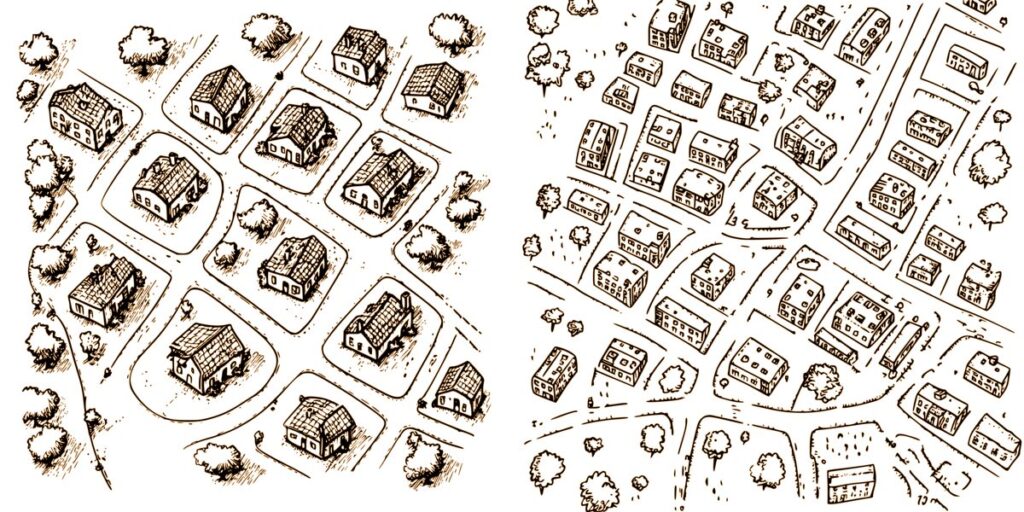
A Neighborhood with a Rural Name
Germantown Road Acres is one of those Bartlett neighborhoods whose name tells part of its story before you ever turn onto a residential street. The word “Germantown” points toward the old north–south road that connects Bartlett with Germantown and the larger Memphis area. “Acres” suggests something equally important: open land, spacious lots, and a time when this part of Shelby County felt more agricultural than suburban.
Unlike older Bartlett landmarks such as the historic downtown district or Cedar Hall, Germantown Road Acres is not defined by a single founding date or one famous building. Its heritage is found in the gradual transformation of former farmland and country homes into a residential community. The neighborhood belongs to a broader chapter in Bartlett’s history—the period when quiet roads, large tracts, and family farms began giving way to modern homes while still retaining a countryside character.
That balance remains part of the neighborhood’s appeal today.
From Union Depot to Bartlett
To understand Germantown Road Acres, it helps to begin with Bartlett itself. The community first developed as Union Depot around 1829, when it served as a major stagecoach stop along the route west from Nashville. After the Memphis & Ohio Railroad replaced stagecoach travel, the settlement continued to grow around its depot and agricultural economy. In 1866, the town was incorporated and renamed Bartlett in honor of Major Gabriel M. Bartlett, a planter whose homeplace stood along the old Raleigh-Somerville Road, now known as Stage Road. ([cityofbartlett.org](https://cityofbartlett.org/55/History?utm_source=openai))
For generations, Bartlett was surrounded by farms and plantations. Roads such as Stage Road, Germantown Road, and Memphis-Arlington Road connected rural households to the town center, markets, schools, churches, and railroad service. Much of what now feels like a developed suburban landscape was once open acreage, pasture, timber, or cultivated ground.
Germantown Road Acres grew out of that rural setting. The neighborhood name is best understood as a descriptive one rather than a reference to a separate historic town. It identifies the area’s location near Germantown Road and emphasizes the spacious parcels that distinguished it from denser residential development.
The Importance of Germantown Road
Germantown Road has long been more than a convenient north–south route. It is part of the network of older roads that shaped the growth of northeastern Shelby County. The road links Bartlett with Germantown, Memphis, and communities farther north and east, making it a natural corridor for farms, homes, commerce, and eventually suburban expansion.
For longtime residents, the road has also served as a kind of visual timeline. Older stretches recall a two-lane country road bordered by fields and scattered homes. Newer sections reflect widened streets, commercial development, traffic improvements, and the steady growth of Bartlett and surrounding communities.
Germantown Road Acres benefited from that changing geography. Families could enjoy larger lots and a quieter setting while remaining close to major routes, schools, shopping, and employment centers. Nearby roads—including Memphis-Arlington Road, U.S. 70, Appling Road, and Germantown Parkway—helped connect the neighborhood to the rest of Bartlett and the greater Memphis area.
A Neighborhood Shaped by Bartlett’s Growth
Bartlett’s transition from a small agricultural town to a growing suburban city accelerated during the twentieth century. The city established essential services, including municipal water in 1951 and a fire department in 1952. In 1967, Freeman Park and Bartlett’s first public library were dedicated, reflecting the community’s growing investment in public amenities. ([cityofbartlett.org](https://cityofbartlett.org/55/History?utm_source=openai))
Those changes created the foundation for neighborhoods like Germantown Road Acres. As roads improved and the Memphis metropolitan area expanded, rural properties became increasingly attractive for residential development. Some land was divided into homesites, while other parcels remained large and wooded. The result was a neighborhood with a less uniform feel than many postwar subdivisions: homes may sit on generous lots, mature trees are common, and the landscape still hints at the agricultural land that came before.
The neighborhood’s evolution was not a single dramatic event. It happened gradually, one property and one family at a time. A farmhouse might be replaced by a newer residence. A pasture might become a homesite. A quiet country intersection might eventually serve as a gateway to a larger subdivision or commercial area.
That slow pace is part of what gives Germantown Road Acres its sense of place.
Historic Landmarks Nearby
Although Germantown Road Acres itself is primarily residential, several Bartlett landmarks help place it within the community’s larger heritage.
- Cedar Hall, built in 1846 at 3712 Broadway Road, is recognized as Bartlett’s oldest remaining building and is listed on the National Register of Historic Places. ([cityofbartlett.org](https://cityofbartlett.org/55/History?utm_source=openai))
- The Gotten House, home of the Bartlett Historical Society and museum, preserves local stories, artifacts, and family histories. The Bartlett Historical Society was chartered in 1982, and the museum was formally dedicated in 1990. ([cityofbartlett.org](https://cityofbartlett.org/55/History?utm_source=openai))
- Davies Manor and Davies Plantation Road preserve another important chapter of the area’s early settlement history. The Bartlett Historical Society identifies Davies Manor as the oldest home in the Bartlett area. ([bartletthistoricalsociety.org](https://bartletthistoricalsociety.org/history?utm_source=openai))
- Freeman Park represents Bartlett’s long-standing commitment to public recreation and community gathering.
- A.E. Beaty Park, located on Memphis-Arlington Road, offers a neighborhood park setting with a walking trail and lake. ([cityofbartlett.org](https://cityofbartlett.org/167/City-Parks-Listing?utm_source=openai))
These places remind residents that Bartlett’s history is not limited to downtown. It is spread across roads, parks, former farm properties, historic houses, schools, and community institutions.
Schools, Parks, and Everyday Heritage
Neighborhood heritage is often preserved through ordinary routines. Children growing up in and around Germantown Road Acres may have attended Bartlett schools, played at nearby parks, participated in youth sports, or visited the Bartlett Recreation Center and public library. Community parks such as Shadowlawn Park, with its baseball fields and pickleball courts, show how recreation has become part of Bartlett’s modern identity. ([cityofbartlett.org](https://cityofbartlett.org/167/City-Parks-Listing?utm_source=openai))
The Bobby K. Flaherty Municipal Center on Appling Road is another example of the city’s evolution. Its campus includes the Bartlett Justice Center, Bartlett Performing Arts and Conference Center, Bartlett YMCA, Appling Lake, and a fitness trail. ([cityofbartlett.org](https://cityofbartlett.org/167/City-Parks-Listing?utm_source=openai))
For families in Germantown Road Acres, these facilities are more than amenities. They are places where neighbors meet, children make friends, and generations share the experience of living in Bartlett.
What Has Stayed the Same
The most noticeable changes over the decades have been growth, traffic, development, and newer construction. Yet the character suggested by the name Germantown Road Acres has endured.
There is still a feeling of space. Mature trees and larger parcels soften the edges of development. Residents remain close to city services without losing the sense that this was once open country. The neighborhood’s location also gives it a distinctive connection to several communities at once: historic Bartlett, the suburban energy around Germantown Parkway, the older agricultural roads leading toward Arlington, and the broader Memphis region.
That mixture is what makes the neighborhood special. Germantown Road Acres is not a museum piece, and it was never meant to be one. Its heritage is living heritage—visible in the road names, the spacious lots, the nearby landmarks, and the stories passed from longtime residents to newcomers.
A Quiet Chapter in Bartlett’s Story
Today, Germantown Road Acres stands as a reminder of how Bartlett grew without entirely losing its rural roots. Its story begins with old roads and agricultural land, continues through suburban expansion, and remains visible in the way residents value privacy, trees, family life, and community connections.
For anyone driving along Germantown Road, the neighborhood may appear simply peaceful and residential. But look a little closer and the older landscape comes into view: the broad acreage, the country-road origins, and the enduring connection to Bartlett’s farming past.
That is the heritage of Germantown Road Acres—a quiet corner of Bartlett where the past has not disappeared. It has simply made room for the present.